

What Your Website Communicates Before Anyone Reads A Word
- Web Design
- Web Development
 Jun 12, 2026

 Share
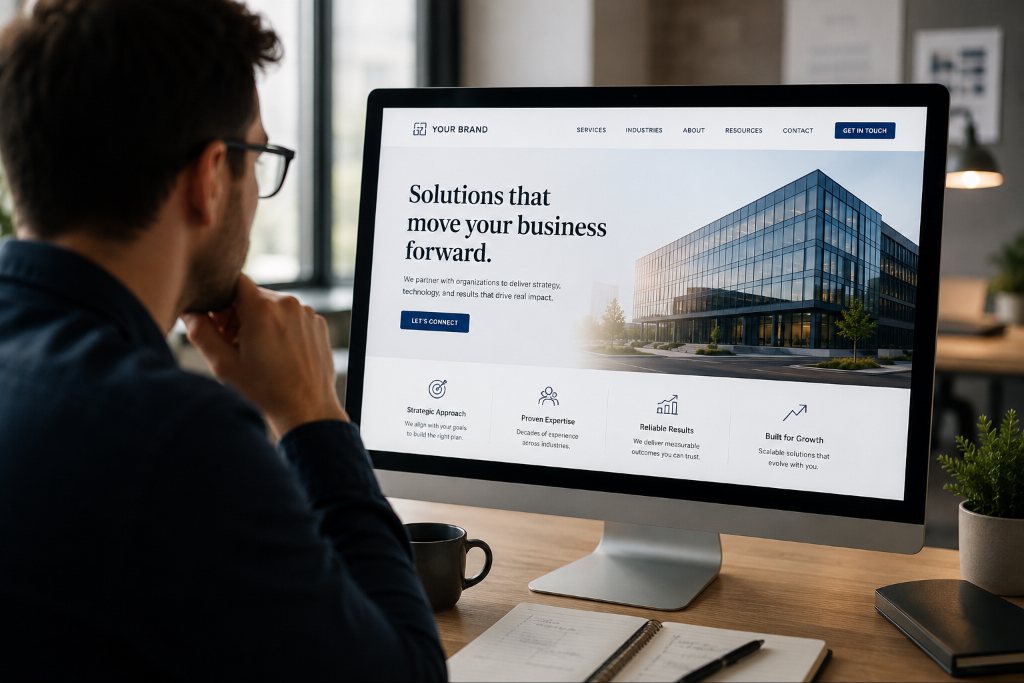
Share Before a visitor reads your headline, clicks your navigation, or scrolls to your services, your website has already made an impression. It has hinted at whether your business feels established or improvised, whether your brand is clear or scattered, and whether you’re worth a few more seconds or a quick trip back to the search results.
That impression is built from layout, photography, typography, color, spacing, navigation, and calls to action, and it lands before your copy gets a word in. For B2B companies, service providers, healthcare practices, manufacturers, financial and law firms, home service brands, and growing local businesses, the stakes are concrete: the person forming that impression is often the same one deciding whether to call you, shortlist you, or trust you with a budget. Web design and branding stop being separate conversations here.
Modern website design isn’t decoration. It’s brand communication
First Impressions Form in Seconds
UX authorities like Nielsen Norman Group have written extensively about how quickly users judge digital experiences. Visitors do not arrive at a website as neutral observers. They make rapid judgments based on what they see, what they understand, and how easily the page helps them orient themselves.
That means your homepage, landing page, or service page is not simply a place to publish information. It is a decision environment.
A strong website quickly tells the visitor:
- You are in the right place.
- This company understands what you need.
- This brand feels professional.
- There is a clear next step.
That communication happens visually before it happens verbally.
Visual Hierarchy Tells Visitors What Matters
One of the most important things a website communicates is priority. Visual hierarchy helps visitors understand what to notice first, second, and third. Figma describes it as a way to guide attention toward the content and tools that meet user needs, and in practice it determines whether visitors understand your offer quickly or feel lost on a page full of competing messages.
Strong hierarchy uses clear headlines, intentional font sizing, consistent spacing, focused calls to action, balanced image placement, and color contrast that guides the eye. Weak hierarchy makes everything feel equally important, which usually means nothing does. A hero section with several competing buttons, a vague headline, unrelated imagery, and no obvious next step creates friction.
The cost is highest in B2B marketing, where prospects are often comparing multiple companies at once. A clear website makes the buying process feel easier, and a cluttered one makes the company harder to evaluate.
Photography Shapes Trust Before Copy Explains It
Photography is one of the fastest ways a website communicates brand character.
Generic courthouse stock makes a law firm look interchangeable. Overly staged photos can make a healthcare provider feel less personal. And outdated facility shots can signal that a manufacturer’s capabilities are behind the times, whether or not that’s the case.
The right photography gives visitors useful context. It shows the people behind the business, the environment where the work happens, the quality of the product, and the experience a customer can expect. It answers the questions a visitor is really asking: who are you, what does it feel like to work with you, what quality should I expect, and are you real, capable, and relevant?
For many service businesses, custom photography is one of the strongest trust signals on a website, because it turns the brand from an abstract promise into something tangible.
Color And Typography Create Emotional Expectations
Color and typography carry meaning before a sentence is read.
Restrained type, high contrast, and generous spacing can make a financial services site feel stable. A wellness brand reaches for warmer tones and softer type to feel approachable, while a technology company uses modular layouts and precise type systems to communicate clarity and innovation. These choices set an emotional expectation before the reader gets to a single sentence of copy.
The key is alignment. A website shouldn’t chase a visual trend just because it feels modern; it should make choices that support the brand’s position. Marty Neumeier’s work on branding helped popularize the idea that a brand is not only what a company says about itself, but how people perceive it. Claim premium on a site that feels crowded and inconsistent, and the promise weakens. Claim innovation on a site that looks dated, and the claim loses strength.
Your visual system should make your positioning feel believable.
Spacing Communicates Confidence
Whitespace is not empty space. In strong digital design, spacing is structure.
The whitespace that looks empty is doing real work: it gives content room to breathe, helps the eye move, makes pages easier to scan, and communicates confidence. Brands that use space well tend to feel more intentional, refined, and trustworthy.
Crowded websites create a subtle sense of disorder, and too many messages competing for attention make a company feel unfocused. Better spacing gives the visitor room to understand what matters. That doesn’t mean every website needs to be minimal. A rich, detailed, content-heavy page can still feel organized when the design creates rhythm.
Google’s Material Design system reinforces the same idea through structured layout, grids, padding, depth, and consistent components, so visitors never have to relearn how to move through a page.
Calls To Action Reveal How Well You Know The Visitor
A call to action is not just a button. It signals what the company believes the visitor is ready to do.
Too many websites ask for commitment too early. “Contact Us” may be appropriate for a high-intent visitor, but not every visitor is ready to talk. Some need to compare services. Some need proof. Some need to understand whether you serve their industry.
Strong websites match calls to action to the visitor journey.
Primary CTAs might include:
- Schedule A Consultation
- Request A Proposal
- Get A Campaign Review
- Talk To A Specialist
Secondary CTAs might include:
- View Case Studies
- Explore Services
- See Our Work
- Learn How It Works
The design of those CTAs matters as much as the language. A primary action should look primary. A secondary action should support exploration without competing. When every button looks the same, the page avoids making a strategic choice.
A strong website guides action without pressure.
Read: How to Generate Leads Using Landing Pages
Trust Signals Make Credibility Easier To Believe
Trust signals help visitors feel safe moving forward. They may not always be dramatic, but they are powerful.
Ask what makes a website credible and the honest answer is a pile of small cues working together: testimonials and named case studies, recognizable logos and certifications, real photos of a real team, and the basics that are easy to overlook, like fast page speed and mobile usability.
The Nielsen Norman Group has noted that credibility is influenced by design quality, writing quality, and useful supporting evidence. Visitors are looking for cues that your company is legitimate, capable, and relevant. In B2B, trust signals matter even more, because the buying decision involves real risk. A prospect may be deciding whether to recommend your company internally, request a proposal, or trust your team with a meaningful budget, and the website has to make that next step feel reasonable.
Consistency Across Digital Channels Strengthens The Brand
Your website does not exist in isolation. It sits next to your ads, your email, your social posts, your sales decks, and whatever people say about you offline, and prospects cross between all of it without noticing the handoffs, until one of them doesn’t match. A polished ad that dumps you onto a tired landing page, or a glowing referral that leads to a site beneath the recommendation, plants a small doubt that’s hard to undo.
Creative authorities like Paula Scher have shown through their identity work that strong brands rely on systems, not isolated visuals. For digital, that means your website, landing pages, ads, email, photography, and social graphics should feel like they came from the same place.
Consistency is less about every asset looking identical than about every asset holding the same standard, so the brand feels like one company wherever someone runs into it.
A Website Should Attract, Engage, And Convert
What separates a good-looking website from one that builds the business? It comes down to balancing brand and performance across three jobs. The first is to attract the right people, through search visibility, relevant content, and a clear market position. Once they arrive, the site has to engage them, with strong design, useful information, and navigation that makes sense. Then it has to convert them, with persuasive messaging, trust-building proof, and clear calls to action.
Those jobs lean on each other. Design gives the visitor confidence, content gives them clarity, and the user experience gives them momentum, while strategy connects all three to a business outcome. A website that communicates well before anyone reads a word gives your written message a stronger chance to work, because it has already created the conditions for attention, trust, and action.
What Is Your Website Saying Right Now?
Before your next redesign, campaign launch, or content update, look at your website without reading the copy.
Scan the first screen. Look at the photography. Notice the spacing. Count the calls to action. Compare the design to your strongest competitors. Ask whether the page feels like the company you want prospects to believe in.
Your website is already communicating.
The question is whether it is saying the right things.
Build A Website That Earns Trust And Leads
Getting all of this right at once is hard, mostly because the pieces tend to live with different people. The brand designer, the content team, and whoever owns lead generation often work from separate plans, and the website is where the gaps show.
Blueprint Digital keeps them on one team. Our design, SEO, development, and strategy specialists work together, so your web design looks like your brand, performs like a lead source, and reflects how buyers in your industry actually decide. We frame the work around outcomes: qualified leads at a defensible cost. If you’re not sure what your website is communicating right now, get a review from our team, and we’ll tell you what we see and what we’d change.
Ready to Dominate Online and Grow Your Business?
Schedule time to connect with Blueprint about your online goals, or request a free review of marketing campaigns.
Related Posts

What Is Automated Lead Follow-Up and How Does It Work

Free Advertising for Nonprofits Through Google Ad Grants

Lead Scoring for B2B: How to Decide Which Leads Your Sales Team Chases



Partner with BLUEPRINT to reach your online goals, grow your business and reshape your story.
Get in touch with BLUEPRINT
Reach out to request a discovery call, a free campaign review, or for all other inquiries.