


 Building a brand strategy for digital marketing campaigns takes more than keeping the visuals aligned and the messaging consistent. Campaigns start to lose their force when teams move too quickly into channels and deliverables before the brand idea is clear enough to guide the work. Everything may be active, polished, and technically in place, yet the campaign still feels generic and hollow because there is no real center holding it together.
We spoke with Kevin Sterner, Creative Director at Blueprint Digital, about the gap between brand thinking and campaign execution, and about the kind of clarity that keeps creative from slipping into something forgettable. His perspective brings the conversation back to a simple point: building effective campaigns starts with a strong connection between digital marketing and brand strategy.
Strong campaigns do not begin with assets or placements. They begin with a message that knows who it is speaking to, what it stands for, and why it should matter.
Why Digital Campaigns Need a Clear Brand Strategy
Digital campaigns often start with the visible parts. Teams get into paid media, landing pages, email, social content, and production because those pieces need decisions right away. The message underneath all of it can still be half-formed, which is usually where the trouble starts. A campaign may look polished, but if the idea holding it together is weak, people are not left with much to remember.
Kevin spoke about the pressure to move fast and how easily brands can slip into execution before the messaging is ready to guide the work.
“Everything in the marketing world moves at hyperspeed. Everybody’s trying to beat each other to market, and that creates a scenario for marketers where you’re tempted to build around tactics before messaging.”
You can see the effect of that in a lot of campaign work. Everything is technically in place, but the message feels broad, safe, or too familiar. A clear brand strategy helps prevent that. It gives the campaign a stronger center, makes the creative more focused, and helps the brand stay with people after that first interaction. Not every message lands on the spot. Sometimes the relevance shows up later, and when it does, people are more likely to return to the brand they already remember.
The Building Blocks of a Strong Brand Strategy
Brand strategy starts with a few core decisions. It defines what the brand stands for, who it is for, and how it should be remembered.
Audience insight comes first
A brand cannot say something meaningful until it has a clear sense of who it is speaking to. Audience insight is where that starts. Good strategy goes past general targeting and gets closer to what people need, what is frustrating them, and what kind of message will feel relevant when they come across it. Without that, campaigns tend to speak in broad language and hope something sticks.
Positioning gives the brand a place in people’s minds
Positioning shapes how the brand is understood and what makes it worth noticing. It gives the campaign a clearer identity and helps the message stand apart from everything else in the category. When that part is fuzzy, the work can start sounding like it could belong to anyone.
Brand promise gives people a reason to care
A strong message carries some sense of what the brand can do for the audience. What solution does the brand offer? What pain point does it meet? A campaign gets stronger when people can quickly sense what the brand helps them solve, improve, or move toward.
Voice makes the brand feel human
Brands are not experienced as logos alone. People get a feel for them through language, tone, and interaction over time. Brands are a living thing, shaped by the company, the people behind it, and even the audience that gathers around it. That idea matters because voice is often what makes the difference between a message that feels managed and one that feels real.
Visual and verbal cues help the message stay with people
Recognition matters, but memory usually comes from more than looking consistent. A brand becomes easier to remember when it leaves behind something with personality. Sometimes it is a visual cue. Sometimes it is a line, a tone, or a moment that feels unexpectedly honest or smart. Kevin talked about giving brands credit when they surprise him or make him smile. People tend to do the same. When a campaign catches attention in a way that feels natural, the message has a better chance of staying with them.
READ MORE: 8 Types of Digital Marketing Every Business Should Know
Turn Brand Strategy Into One Clear Campaign Idea
A strong brand strategy for digital marketing campaigns starts to feel real when it becomes one idea that the whole campaign can carry. Kevin puts it plainly: teams have to think simple, even though simple is rarely easy.
“One clear idea at the center of the campaign.”
A central idea gives paid media, landing pages, email, social, and video something shared to build from. The execution can change from channel to channel, but the message, tone, and promise still need to feel connected. A long-form video can carry a fuller story, while a social ad may only have room for one sharp cue. That difference is part of why drip campaigns work so well. They allow the brand to build meaning over time, with each touchpoint adding another piece of the same central idea. As those pieces start to connect, the pattern becomes clearer and trust begins to build.
This clear alignment matters because people rarely move from awareness to action in a straight line. Google’s research on the messy middle describes a buyer journey where people loop between exploring and evaluating options, and its newer retail research says 8 in 10 online purchase journeys involve multiple touchpoints. When the campaign idea is clear, those repeated encounters start to reinforce each other instead of competing for attention.
A shared thread is what keeps a campaign from turning into a collection of unrelated assets.
Adjusting the Message for the Buyer’s Stage of Decision
A campaign can carry one strong central idea without sounding the same at every stage. Buyers who are still exploring need a different kind of message than those who are already comparing details and moving closer to a decision.
The goal is to keep the brand promise intact while adjusting the message to where the audience is in the journey. Early messaging can build awareness and interest, while later messaging can offer the proof and reassurance that help turn attention into action.
Excellence Gets the Stop, Story Earns the Stay
“Excellence has stopping power, and story has staying power… (Excellence) doesn’t just always have to be drop-dead cool. It’s a whole combination of things that attract us… It’s what stops you and goes, wait, this is great, I resonate with this.”
A campaign has to earn the pause before it earns anything else. Something in the work has to feel sharp enough, clear enough, or compelling enough to break through for a second. But attention alone is thin. The part that lasts is the part people can feel, return to, and carry with them after that first moment passes.
Because there are so many things vying for attention, people give their interest and trust to only a handful of brands that meet real needs in their lives. Once a brand reaches that point, the relationship changes. Trust creates patience. It creates loyalty. It gives the brand more room to hold its place in someone’s mind, even when everything else is trying to take it.
“And until they fail me… and that’s the amazing thing about trust in a brand. I may have such trust in a brand over a period of time, and I’m such a champion for that brand, that even if they do fail, even if they launch a product that is totally miserable… I’m not gonna stop using Apple computers… I’m gonna wait… and they’re gonna come out with an even better computer next time.”
The Train Tracks Analogy
What does brand strategy really do once a campaign is out in the world? One good way to picture it is through a train ride. Strategy is the rails. Story is everything people experience along the way.
Kevin puts it like this.
“It’s not about the fact that you’re on a train, it’s about what kind of life are you living while you’re on that train. You’re seeing all the sights of the countryside… So, it’s like the strategy is the rails. That keeps people tracking toward the brand, which ultimately will result in trust. But the brand story is this story that everybody’s bought into, and deeper and deeper and deeper as you move toward the brand, toward intimacy with the brand.”
Seen that way, storytelling is not just something layered on top of the campaign. It is what makes the brand feel lived in. The strategy keeps everything on course, but the story is what people begin to buy into more deeply over time. That is how a campaign can meet people at different stages without losing the truth of what the brand stands for.
How to Tell When Brand Strategy Is Strengthening the Campaign
You can usually feel it before you see it in a report. The work starts getting tighter. The message lands faster. The campaign feels less like a set of separate pieces and more like one clear idea showing up across different touchpoints. That is the first shift. Then the numbers start catching up.
A stronger brand strategy usually shows up in a few clear ways
- The creative feels sharper and more cohesive
- The audience understands the message with less friction
- Decision-making gets easier because the value is clearer
- Engagement improves, along with conversion quality
- Sales has less heavy lifting to do because people come in more convinced
- Testing becomes more useful because it is easier to see why one message is working better than another
A campaign with a stronger strategic center does not just perform better. It becomes easier to learn from. When one version starts pulling harder, the next question is no longer just which one won. It becomes why it won, and that makes the next round of creative smarter.
What Strong Brand Strategy Looks Like in Real Campaigns
Kevin points to Volkswagen’s Think Small campaign as one of the best examples.
It launched in the United States in 1959, when most car ads were built around size, speed, shine, and status. The Beetle stood far outside that ideal. It was small, plain, and foreign, and the campaign did not try to smooth any of that over. It made those differences the heart of the message.
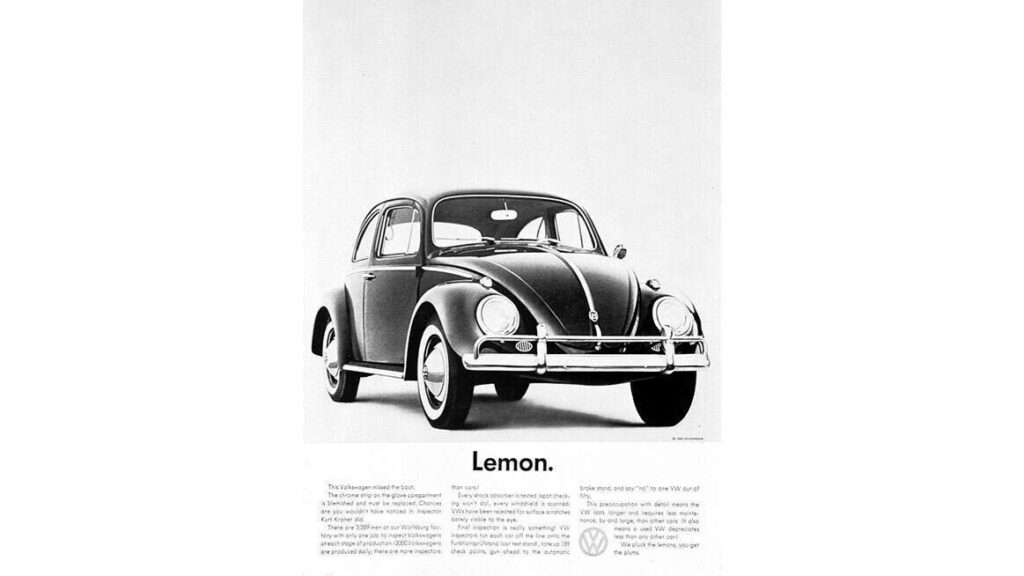
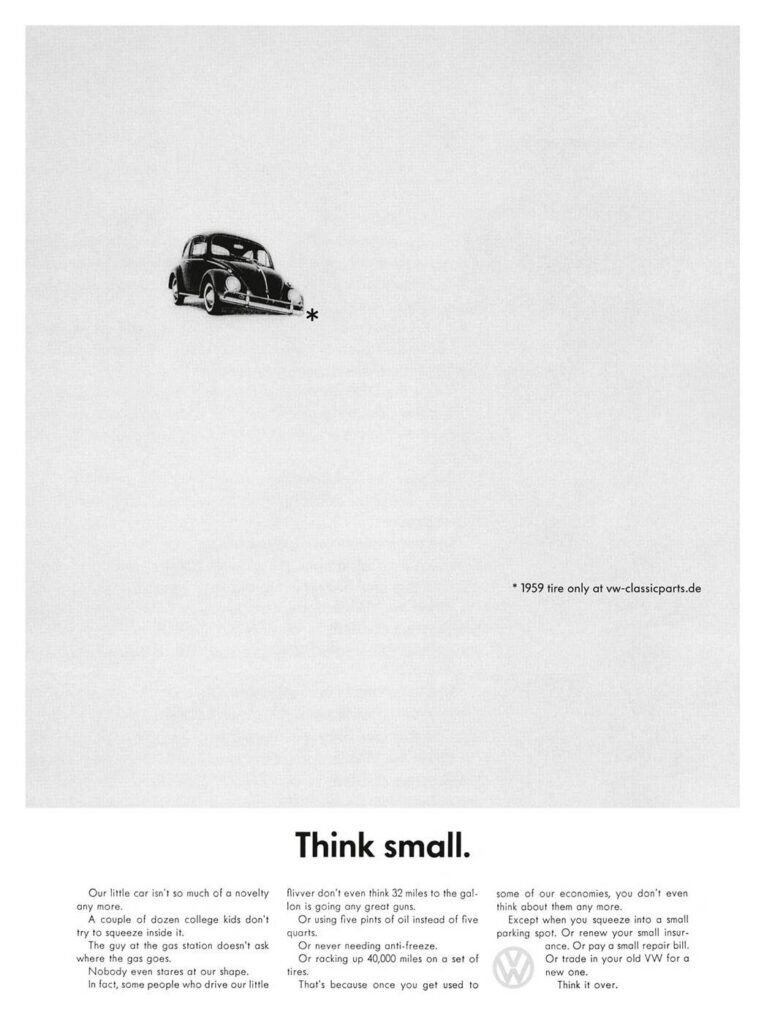
Volkswagen Think Small ad images sourced from Ads of the World and Volkswagen Group.
You can see that immediately in the ads themselves. Think Small places a tiny Beetle in a huge field of white space, then follows with copy that treats smallness as a practical advantage. Instead of selling fantasy, the ad talks through the kinds of things drivers would care about in everyday life, like strong gas mileage, using less oil, longer tire life, easier parking, and lower insurance and repair costs. It makes the car feel sensible, reliable, and quietly smart. The Lemon ad uses the same stripped-down look, but with a more provocative headline. It grabs attention with what sounds like bad news, then turns that word around in the body copy by explaining that the car was rejected over a minor blemish. What first reads like an insult becomes proof of careful inspection and strict quality standards.
The Think Small campaign gave the Beetle a clear point of view in a market full of sameness. That is what strong brand strategy does. It makes the difference feel like the reason to choose.
Build Smarter Campaigns With Blueprint Digital
Strong campaigns do not start at the channel level. They start with a clear idea, a defined promise, and a message that can hold together as people move from first impression to buying decision. That is the difference between campaign activity that looks busy and campaign execution that feels connected, persuasive, and memorable.
Blueprint Digital helps brands bring that clarity into the work before the campaign gets fragmented across platforms and formats. By connecting SEO, paid media, email marketing and SMS, and creatives to the same core message, Blueprint helps campaigns stay cohesive from first touch to final action. That kind of connected execution gives brands a better chance to earn attention, build trust, and convert with more consistency.
Schedule a discovery call with Blueprint Digital and build campaigns that stay connected from strategy to conversion.