

The B2B Marketing Automation Stack We Build for Clients
- Marketing
 Jul 13, 2026


 Share
Share A lot of B2B teams do everything the automation playbook asks. They buy the platform, build the workflows, connect the forms, and turn on the sequences. And still the qualified leads stall somewhere between the first click and a signed deal, and nobody can say which part of the funnel is failing.
We sat down with Abbey Reid, Blueprint Digital’s CRM and automation specialist, to talk through how she builds these systems for clients and where she sees them break. To Reid, the problem is almost never the software. Automation speeds up whatever process it is handed, and when that process is broken, faster software only produces faster failure. A B2B marketing automation strategy works or fails on the process underneath: how leads get captured, scored, and followed up before anyone opens the CRM.
What a Well-Built B2B Marketing Automation Stack Looks Like
Reid builds the stack as a set of layers, each owning a single stretch of the lead’s journey and passing it cleanly to the next. No lead slips into the gap between the click that created it and the salesperson who should close it. Clean handoffs matter most to B2B companies with high-value accounts, where one dropped lead can be a lost deal worth chasing for months.
At the core of every build is Go High Level, a CRM platform that keeps the contact database, sales pipelines, automations, email and SMS, calendars, forms, and reporting together in one place instead of spread across separate subscriptions. The rest of the stack arranges around it:
| Layer | What runs it | What it does |
| Core CRM | Go High Level | Holds contacts, pipelines, automations, email and SMS, calendars, forms, and reporting in one system |
| Lead capture | Landing pages, website, Google Ads, Facebook lead forms, chat widgets, inbound calls | Routes every inbound lead into one place, where nothing gets lost |
| Automation | Go High Level workflows | Assigns each lead, sends instant text and email replies, notifies sales, creates tasks, starts follow-up |
| Integration | Zapier | Connects the CRM to accounting software, ERPs, custom databases, or industry apps when needs get complex |
| Reporting and attribution | Go High Level dashboards | Shows where leads came from, which campaigns generate revenue, and where deals get stuck |
The integration layer leans on Zapier, which passes information between apps automatically and lets the stack reach systems Go High Level doesn’t cover, without anyone re-keying data by hand.
The clearest test of the stack is the first hour after a lead converts… The point, in Reid’s words, is that “nobody has to wonder what happens next”: everyone on the team knows their next step, the customer gets an immediate response, and the business moves from selling to delivering without a manual handoff.
Three Marketing Automation Mistakes That Stall B2B Pipelines
Across B2B accounts, the same three failures surface again and again, each a process gap that automation then scales.
Wrong Automation Tool for the CRM
“We’d rather have one platform used to ninety percent of its potential than ten platforms each used at ten percent. If your sales team or your front office won’t open a tool every day, it doesn’t matter how powerful it is. Good software only helps when people actually use it.”
Abbey Reid, CRM and Automation Specialist at Blueprint Digital
The first mistake is adding tools that don’t fit how the business runs. Reid often opens an account and finds fifteen or twenty subscriptions layered on top of each other, many of them bought for a single feature and forgotten within a few months. Before a new tool joins the stack, it has to pass a simple test: it should save time, make money, or improve the customer experience, and it should do something Go High Level can’t already do. Even then, one question decides whether it stays. Will the team use it every day? If not, it doesn’t matter how good the tool is. It becomes another cost and another system to maintain.
No Lead Scoring Logic
The second mistake shows up in how leads are scored, or rather, how they aren’t. Every lead gets treated the same, because nothing in the system decides who is ready for sales. Over a long B2B cycle, treating everyone alike gets expensive fast, with reps spending hours on leads that were never a fit while genuine buyers wait for a call. A good scoring model watches a few signals that predict intent, not noise:
- Fit: the lead’s geography, industry, and company profile.
- Stated need: the specific problem they named when they first reached out.
- Behavior: the pages they spend time on and how long they read about a service or pricing.
Weighted together, those signals decide who gets a call now and who can wait.
Workflows Without a Nurture Strategy
The third mistake is running workflows with no nurture strategy behind them. From the outside the automation looks healthy: workflows fire on schedule, emails go out, tasks get created. What’s missing is the plan those workflows are supposed to serve, a deliberate sequence that moves a buyer from first interest toward a decision. The gap usually shows up right after the first touch. A lead misses one call and, instead of dropping into a steady rhythm of texts, calls, and follow-up emails, goes quiet and gets forgotten. Automation layered over a follow-up process that thin only reaches the dead end faster.
How To Diagnose a Stalled B2B Sales Pipeline
When results drop, the easiest target is the most visible symptom, which is rarely the cause. Reid looks at three things, in order:
- Where the leads come from, and whether they’re the right ones. Which channels bring in inquiries, what each lead costs, and, most of all, which sources turn into paying customers. If the audience is wrong at the top, nothing downstream can fix the numbers.
- What happens the moment a lead arrives. How fast the first response goes out, whether anyone reaches the lead at all, and whether follow-up holds up past the first try. Some businesses spend thousands generating demand, then wait a day or two to call, by which point the prospect has moved on.
- Where deals stall in the pipeline. Appointments booked but not kept, proposals sent but never signed, prospects who disappear after a good first call. Every pipeline has one main chokepoint, and finding it points to the biggest gain available.
“Don’t assume the problem is where the frustration is. If sales are down, it doesn’t automatically mean the sales team is underperforming. It could be poor lead quality, slow response times, weak follow-up, or a broken handoff between marketing and sales.”
Abbey Reid, CRM and Automation Specialist at Blueprint Digital
Worked in sequence, those three checks usually turn a vague “sales are down” into one specific, fixable failure. Tracing the whole journey before changing anything is what surfaces it, and once the full path is visible, the drag on lead generation is usually easy to spot.

Abbey Reid
CRM and Automation Specialist
Request a FREE campaign review and customized action plan from Abbey
Request a FREE campaign reviewMulti-Location Chiropractic Automation Case Study
One of Blueprint’s clients puts the pattern in plain view. The practice runs three chiropractic clinics in a mid-sized metro, with skilled clinicians, loyal patients, and strong word of mouth, yet growth had flattened. New-patient bookings wouldn’t climb, and the marketing looked busy (Facebook ads, boosted posts, the occasional email blast) while the schedule stayed flat.
The first month of discovery turned up three problems feeding one another:
- Rising cost, falling quality. Broad “book now” ads tuned for clicks pulled in form fills from outside the service area or for treatments the practice didn’t offer, and cost per lead had reached $58.
- Plenty of inquiries, few patients. Steady form fills produced few booked appointments, and any lead that missed the first call was often never contacted again.
- A stretching sales cycle. The trip from first inquiry to booked visit had reached twelve days, and with wasted ad spend, staff hours, and no-shows added in, the true cost of a new patient sat near $310.
Blueprint’s response focused on three areas: the top of the funnel, the follow-up process, and the front desk’s read on lead quality. Four changes carried it:
- Sharper targeting. Broad “anyone nearby” audiences gave way to intent-based targeting aimed at people actively searching for pain relief, injury recovery, and specific chiropractic services within a realistic service radius.
- Scoring paired with multi-touch follow-up. A simple model weighted geographic fit and stated need (back pain, sports injury, auto accident, wellness care) alongside behavioral signals, wired to automated text, call, and email sequences that kept any inquiry from going cold after a single missed call.
- Marketing and front-office alignment. Blueprint and the office managers settled on what a ready-to-book lead looked like, set up tracking from inquiry through booked appointment, and built a feedback loop for staff to flag mismatched leads back into the targeting.
- Consideration-stage content. Condition-specific landing pages, patient testimonials, and a plain “what to expect at your first visit” guide replaced the generic awareness posts.
Six months in, the numbers moved together rather than in isolation. Cost per lead fell from $58 to $33, and monthly inquiries climbed from 180 to 305, but the bigger change was quality. Nearly twice the share of inquiries turned into booked visits, and the ones that booked did it in days instead of weeks. Because more of the leads were the right ones, the practice’s true cost of acquiring a patient dropped from $310 to $180, a 42 percent fall even as volume grew.
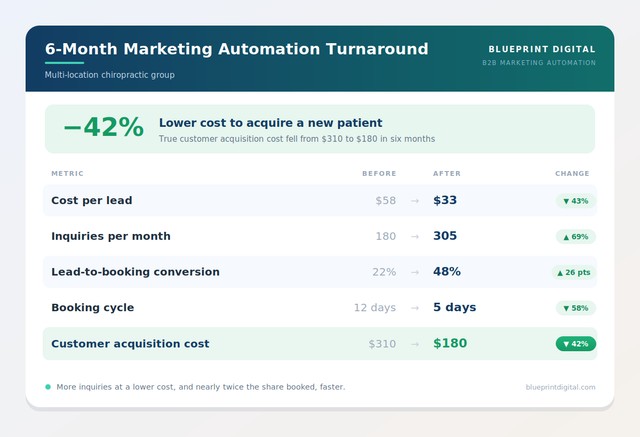
For a stalled schedule, the answer is rarely more ad spend. It’s better aim, quicker response, and a shared definition, between marketing and the front desk, of what a ready patient looks like.
How Blueprint Builds B2B Automation Differently
What sets Blueprint’s builds apart is the order of operations. A lot of agencies lead with tactics: a CRM, a few workflows, a campaign to show early movement, all before anyone has asked how a lead moves through the business. Blueprint answers that first: how prospects find the company, who handles follow-up, what makes a lead qualified, when a prospect becomes a customer, and where people stall. The technology comes afterward, shaped around the answers.
The other half of the approach is thinking past today. Building automation that works now is the easy part, and the harder question is whether it still holds up a year from now, after the business has opened another location, added a service line, or hired another salesperson. Blueprint builds its marketing automation systems to be scalable, documented, and simple enough to change that clients aren’t calling over every small edit. As Reid puts it, “technology should support the business, not dictate how the business operates.”
The same principle reshapes how a director should size up a vendor. The questions that separate a genuine partner from a features pitch are how they plan to learn the business, map the sales process, define what success looks like, and keep the system working six months after launch. A platform can do a lot on paper. What matters is whether the team behind it understands where a specific business makes and loses money.
“Don’t buy automation. Buy a better business process. If your sales process is inconsistent and your follow-up is slow, more software won’t fix it, it only makes the problems harder to see. The best automation almost disappears: your team spends less time on repetitive work, your customers get a smoother experience, and leadership gets better data to decide with.”
Abbey Reid, CRM and Automation Specialist at Blueprint Digital
Build a B2B Automation Stack That Scales
A stalled pipeline almost always tells the same story. The tools are running, the dashboards look busy, and somewhere in the middle, good leads stop turning into customers. The software isn’t the culprit. The process underneath it is, and no platform, however good, can automate its way around a step that’s broken.
Blueprint Digital exists to find that break, fix the process, and let the automation do what it does well. If your stack is producing motion but not pipeline, the answer probably isn’t another tool. It’s a closer look at how a lead travels from first click to closed deal. Schedule a discovery call, and we’ll show you where yours is losing leads and what to do about it.
B2B Marketing Automation FAQs
What is a B2B marketing automation stack?
A B2B marketing automation stack is the connected set of tools a company uses to capture, route, and follow up with leads automatically. A CRM sits at the center to store contacts, manage pipelines, and track performance, supported by a lead-capture layer, an automation layer that triggers follow-up, and an integration layer that links the CRM to other systems. Each layer does one job and hands the lead to the next.
Can marketing automation fix a broken sales process?
No. Automation speeds up whatever process it runs on, and a broken process fails faster and at higher volume once it is automated. Fixing the process comes first, which is why an audit of lead sources, response time, and follow-up usually precedes any new software.
What’s the difference between a CRM and marketing automation?
A CRM is the system of record: it stores contacts, tracks deals, and shows where each one sits in the pipeline. Marketing automation is the layer of workflows that acts on that data, sending follow-ups, assigning leads, and moving them between stages. Most stacks use both, with the automation running on top of the CRM.
How long does B2B marketing automation take to show results?
Most programs show meaningful results within three to six months. The timeline depends on how much of the underlying process needs fixing, not just how fast the software is switched on, which means a clean process pays off sooner than a broken one.
Ready to Dominate Online and Grow Your Business?
Schedule time to connect with Blueprint about your online goals, or request a free review of marketing campaigns.

Related Posts

What Is Automated Lead Follow-Up and How Does It Work

Free Advertising for Nonprofits Through Google Ad Grants

Lead Scoring for B2B: How to Decide Which Leads Your Sales Team Chases



Partner with BLUEPRINT to reach your online goals, grow your business and reshape your story.
Get in touch with BLUEPRINT
Reach out to request a discovery call, a free campaign review, or for all other inquiries.