

AI Content and SEO: How Content Inflation Is Reshaping Search
- Artificial Intelligence
- Search Engine Optimization
- SEO
 May 28, 2026


 Share
Share Every SEO I talk to right now is carrying some version of the same worry: that the thing we spent careers getting good at just got automated, and that we’re now competing against software that drafts passable AI-generated content in nine seconds. I felt it too. For about a year I framed the whole shift as a quality fight, humans versus machines, real writing versus the slop. I was wrong about what was actually happening, and being wrong about it cost my team time we didn’t need to lose.
What I missed was that the shift was about price, not quality. Once that landed for me, a lot of the anxiety became something more useful, which was a working theory of where the advantage had gone.
Google Was Never Against AI-Generated Content
The loudest debate in our field is whether AI content is good or bad, as if a page’s worth is decided by what typed it. Google settled that question years ago and keeps repeating itself. Its official guidance on AI-generated content says plainly that it rewards high-quality, original, people-first work regardless of how it’s produced, and treats automation as a problem only when the point is to manipulate rankings rather than help someone.
So the human-versus-machine framing was a dead end. The line that’s always mattered runs between content that earns its place and content that just sits there, and AI didn’t shift that line so much as let everyone reach it faster, in either direction. Weak editorial process now produces weak work at a speed that would have been impossible two years ago. Strong process gets that same speedup pointed the other way. The teams I see struggling didn’t get worse at their jobs; they sped up the same flaws they already had.
When AI Made Content Cheap, the Web Filled Up Fast
Before these tools, content was rate-limited by human hours. Research, drafting, editing, expert review… Every step cost time and money, and that cost kept supply in check. Most of us never thought of scarcity as the thing protecting our work, but it was.
Then the marginal cost of one more page fell close to zero, and the web’s content supply climbed steeply in response. The currency comparison is the cleanest way I’ve found to explain it to a CFO. When you print more money, each dollar buys less. When you publish more interchangeable pages, each one earns less attention, fewer rankings, and a smaller share of the finite crawl and trust search runs on. The web doesn’t have a content shortage now; it has an oversupply of pages that all say roughly the same thing. I’d bet some of yours are in that pile. A year ago, plenty of mine were.
Why Google Is Getting Stricter About What It Indexes
The economics stop being abstract once you look at how Google runs its index. Its crawl budget documentation is candid about it: crawling is a finite resource Google allocates by popularity, uniqueness, and value to users, which means a large fraction of what gets published never gets prioritized. As the supply of cheap content climbs, those allocation decisions only get stricter.
You can watch it happen inside Search Console. Pages pile up as crawled-but-not-indexed or discovered-but-not-indexed, while thin programmatic pages never gain traction and near-duplicate clusters cannibalize each other. In March 2024, Google made the stance explicit by adding scaled content abuse to its spam policies and folding its helpful-content system into core ranking, with the stated aim of cutting low-value, unoriginal results by roughly 40 percent. The policy is plainly worded: mass-producing pages to win rankings is spam no matter who or what wrote them.

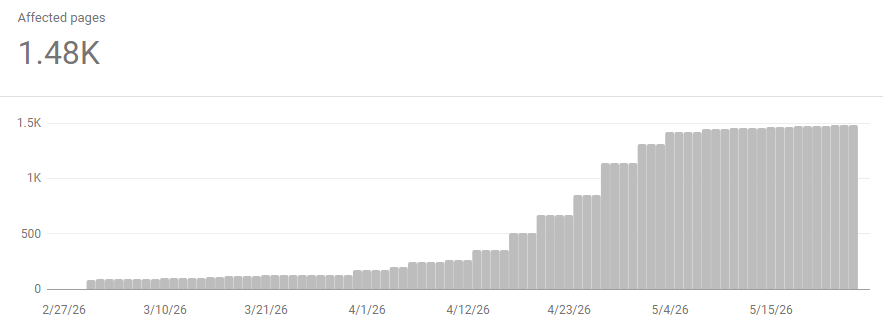
So publishing more isn’t a strategy on its own; it’s frequently a reverse one, because low-value content burns crawl equity and earns nothing back. Google is growing more selective about what it crawls, indexes, and rewards, and the more the web inflates, the more selective it has to be.
Anyone Can Publish Now, and That’s the Catch
The uncomfortable part of commoditization is that it commoditizes you too, if you let it. When anyone can generate a competent page on a common topic, a competent page on a common topic stops being worth much. The production speed you were proud of becomes baseline.

What doesn’t commoditize is everything the model can’t supply on its own. Feed a model generic context and you get generic output, because there’s nothing distinctive for it to draw from in the first place. The teams pulling ahead have built an operation around the tool: documented editorial standards, search-intent frameworks worth using, internal linking systems, and human review that actually changes the draft. The model produces text. Whether that text is worth a reader’s time gets decided by the brief, the editorial standards, and the editor who actually pushes back on what came out.
Where Scarcity Went
If price is no longer the constraint, the advantage shifts to whatever still is scarce, and what’s still scarce is signal: the markers that tell Google and a reader that this page came from someone who actually knew the topic.
Proprietary context is one half of it. The strongest systems feed the model something competitors can’t copy, like customer interviews, sales-call transcripts, first-party data, and the hard-won knowledge already sitting inside your organization. Two companies can run the identical AI platform and get completely different results, because the moat was never the platform itself; it was always the context and the operational rigor wrapped around it. Building that into a repeatable system is the actual job of any AI SEO strategy that’s going to last past a single quarter.
Brand authority is the other half, and it compounds. As generic information gets cheaper, a recognizable point of view gets harder to replace, and trust built over years is the one thing a competitor can’t generate on a Tuesday afternoon. Those are precisely the signals search leans on harder every year. AI can accelerate that work, but it can’t manufacture the expertise sitting underneath it, which is the part of all this I keep finding reassuring. The craft didn’t disappear when the cost of production fell; it relocated to harder ground.

If You’re Still Working Out Where AI Fits in Your Strategy
The brands that win the next phase of search will be the ones treating AI as leverage on top of genuine expertise, not the ones treating it as a shortcut around the expertise problem. At Blueprint, that’s the bet we’ve built our whole content practice around: that operational discipline and earned authority beat volume every time the supply curve shifts, and it just shifted hard. If you’re working out where AI fits in your own search strategy and want to compare notes, come talk to us. I’d rather build the durable version of this with you than watch another quarter of good teams adding to the pile.
Ready to Dominate Online and Grow Your Business?
Schedule time to connect with Blueprint about your online goals, or request a free review of marketing campaigns.

Related Posts

What Is Automated Lead Follow-Up and How Does It Work

Free Advertising for Nonprofits Through Google Ad Grants

Lead Scoring for B2B: How to Decide Which Leads Your Sales Team Chases



Partner with BLUEPRINT to reach your online goals, grow your business and reshape your story.
Get in touch with BLUEPRINT
Reach out to request a discovery call, a free campaign review, or for all other inquiries.